Robust Theme
Dec 09, 2019 2020-04-08 7:40Robust Theme


Obama's Reaganesque Style
In 1983,” wrote Barack Obama,
“I decided to become a community organizer; I didn’t know anyone making a living that way. When classmates in college asked me just what it was a community organizer did, I couldn’t answer them directly. Instead, I’d pronounce the need for change. Change in the White House, where Reagan and his minions were carrying on their dirty deeds. Change in the Congress, compliant and corrupt. Change in the mood of the country, manic and self-absorbed. Change won’t come from the top, I would say. Change will come from mobilized grassroots. That’s what I’ll do; organize black folks. At the grassroots. For change.”
On October 27th, 1964, Ronald Reagan addressed an audience on behalf of Barry Goldwater, the Republican candidate for the 1964 US Presidential elections. His speech entitled “A Time for Choosing” illuminated the present and future dangers of liberalism. Reagan, a lifelong Democrat turned Republican held a unique perspective on the underlying forces that were rising. So much so that during his speech, he said,
We’re at war with the most dangerous enemy that has ever faced mankind in his long climb from the swamp to the stars— it is said that if we lose that war and in so doing lose this way of this freedom of ours, history will record with the greatest astonishment that those who had the most to lose did the least to prevent its happening. We ask ourselves: Do we still know the freedoms that were intended for us by the Founding Fathers? This idea that the government is beholden to the people and that it has no other source of power except the sovereign people is still the newest and most unique idea in all the long history of man’s relation to man.
For Reagan to choose the words: "the most dangerous enemy that has ever faced mankind" on the heels of World War II seems incomprehensible. However, Reagan saw a growing chasm between a Constitutional America designed to grant American freedoms through the “capacity for self-government” and the ease in which the government was enabling Americans to “abandon this freedom, won through the American Revolution, through believing that “a little intellectual elite in a far-distant Capitol can plan our lives for us better than we can plan them ourselves.” And, if one connected Germany’s moral decline to intellectual elites, then Reagan’s warning was not without credence.
“You and I, he said, are told increasingly that we have to choose between a left or right. I would like to suggest there is no such thing as a left or right; there is only an up and down.”
What did Reagan mean by up and down? He believed that up lays a man’s dream to possess the ultimate in individual freedoms according to moral law and integrity. And “down” was the path towards totalitarianism, a path that reduced personal freedoms for collective economic and national security—cloaked in the guise of government control through humanitarian platitudes.
His rebuke of President Lyndon B. Johnson and his Great Society was in the strongest of language, highlighting the dangers of liberal socialism and how they were entering the American consciousness. President Johnson told the citizens of America that they “must accept a greater government activity in the affairs of the people.”
Regarding the Cold War, Reagan called out anti-American voices within the Johnson administration. Voices that were saying, “the Cold War will end through our acceptance of not undemocratic socialism (Communism). Or, the profit motive (Capitalism) has become outmoded; it must be replaced by the incentives of a welfare state (Marxism). Or, our traditional system of individual freedom (self and Constitutional government) is incapable of solving the complex problems of the twentieth century. (Totalitarianism).”,
He called out political actors infiltrating academia with anti-Constitutional bias. One such actor was Senator Fulbright, who said at Stanford University, “the Constitution is outmoded” while referring to President Johnson as “our moral teacher and our leader” who is “hobbled in his task by the restrictions of power imposed on him by this antiquated document. He must be free so that he can do for us what he knows is best.” Hitler made a similar remark about creating a new set of Commandments to free h from the moral constraints of the Ten Commandments.
Regarding liberalism, Reagan highlighted the words of Pennsylvanian Senator Clark, who defined liberalism as “meeting the material needs of the masses through the full power of centralized government.”—the very thing the Founding Fathers sought to minimize.
By 1964, over thirty years of liberal Presidents had fomented the idea of socialism in America. For example, during the Johnson administration, in Chico County, Arkansas, James Wear over-planted his rice plot. The government obtained a $17,000 judgment, and subsequently, the US Marshal sold his 960-acre farm at auction. The government said it was necessary as a warning to others to “make the system work.” And the very fact that Norman Thomas of Minnesota University quipped on February 19, 1964, that, “If Barry Goldwater became President, he would stop the advancement of socialism in the United States.”—is telling o the inroads socialism was making since President Roosevelt.
“As a former Democrat,” said Reagan, “I can tell you Norman Thomas is not the only man who has drawn this parallel to socialism with the present administration. Because, back in 1936, Mr. Democrat himself, Al Smith, the great American, came before the American people and charged that the leadership of his party was taking the part of Jefferson, Jackson, and Cleveland down the road under the banner of Marx, Lenin, and Stalin.” Reagan called the liberal utopian solution of peace without victory accommodation. “If we will only avoid any direct confrontation with the enemy,” Reagan said, “he will forget his evil ways and learn to love us.” He continued, “there is no argument over the choice between peace and war. But, there is only one guaranteed way you can have peace. And you can have it in the next second, surrender. Admittedly, there is a risk in any course we follow other than this. But every lesson of history tells us that the greater risk lies in appeasement. And this is the specter that our well-meaning liberal friends refuse to face, that their policy-of-accommodation is appeasement. And it gives no choice between peace and war—only between fight or surrender."
In 1964 Ronald Reagan was a voice from Hollywood that called out the underlying forces that would cause the second American Revolution after the re-election of Lyndon B. Johnson. Social Communism cloaked in Marxist ideology was a threat both internally and externally—but the real danger came from elected officials who believed that intellectual elites and their voice of appeasement knew better than the Founding Fathers, the moral framework of the Constitution, and the American citizens who voted.
In 1967, Reagan became the 33rd governor of California, and in 1981, he became the 40th president of the United States of America. His legacy and accomplishments are unparalleled in the Presidential history of the United States. Reagan understood the stakes of freedom. His foreign policy relentlessly engaged the underlying forces of liberalism and Communism to bring about the fall of the Berlin Wall, the collapse of the Soviet Union, and the retreat of Marxist theory in the public sphere of America.
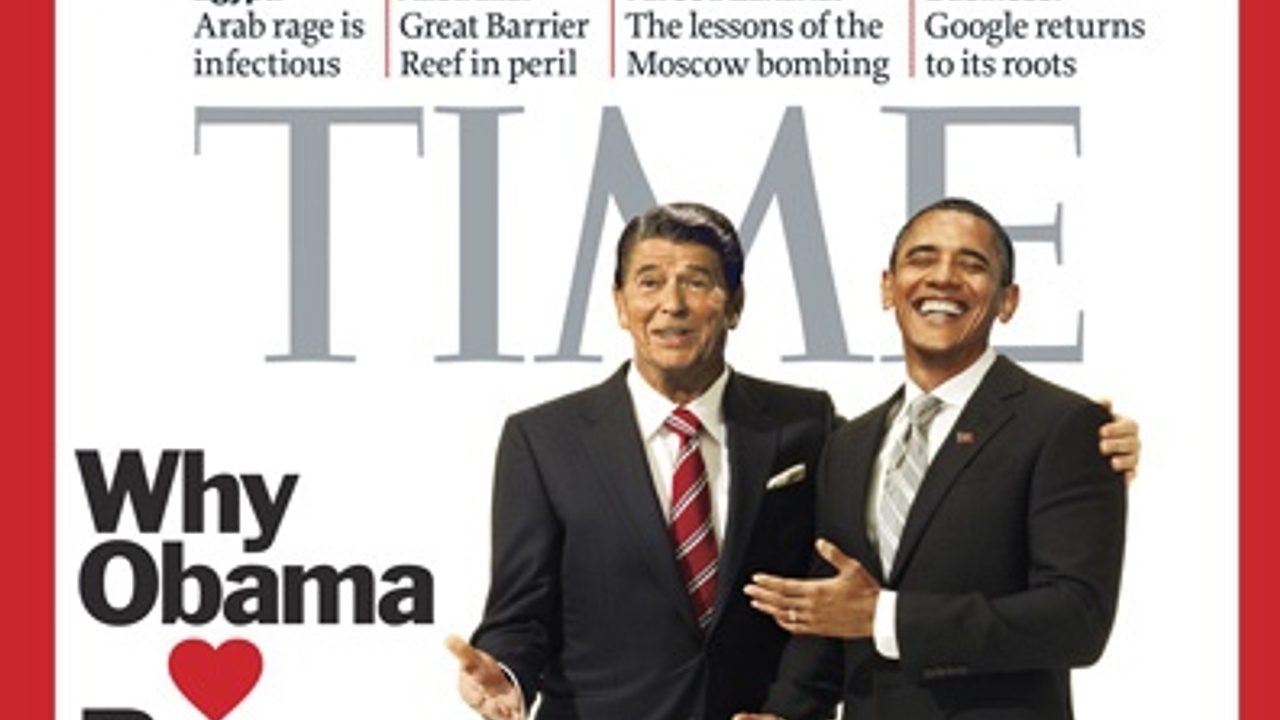
Almost twenty years after the presidency of Ronald Reagan, Barack Hussein Obama became the 44th President of the United States of America. A man who embodied progressive liberalism, the ideology Reagan fought to eradicate. Oddly, the Conservative Reagan became the role model of Obama, the progressive—for both National and Foreign policy. Douglas Brinkley, who edited the diaries of Reagan, attended a dinner for Presidential historians hosted by President Obama. He left with a clear impression that Obama had found a role model. “There are policies, and there is a persona, and a lot can be told by persona,” he said. “Obama is approaching the job in a Reaganesque fashion.” Notably, Obama did not see Reagan as a role model of conservative principles; but for transformative progressive principles. He saw Reagan as his “point of reference.” Through the use of mirroring techniques, he believed he could replicate Reagan's persona to “change the trajectory of America.”
Tom Nichols, a professor of national security affairs at the US Naval War College, wrote an article highlighting the stark differences between Reagan’s 1987 nuclear agreement with the Soviet Union and Obama’s Iranian Nuclear Deal of 2016. In Obama’s mind, he was replicating Reagan on the international stage by using Reagan’s Soviet Arms Deal to justify his actions. The outcome of each deal was dramatically different: Reagan brought down an evil regime: the Soviet Union—causing it to reject its ideology, disarm its already existing nuclear stockpile, and by 1987, as much as was possible, help them become “a status-quo power, invested in the international system as it was constituted.”
Reagan’s policies culminated in dismantling the Berlin Wall, the freeing of East Germany, and the world of Communist encroachment. In contrast, Obama empowered an evil regime: The Islamic Republic of Iran, while destroying the status-quo power of several countries in the Middle East—Egypt, Libya, Turkey, Syria, and Yemen. A status-quo power is a country that can make and maintain a deal. Iran is many things—authoritarian, theocratic, delusional—but it is not a status-quo state—unlike the Soviet Union. Hence, Obama’s Iranian Nuclear Deal empowered the Iranian regime to expand its global network of terrorism and institute increased uranium production for nuclear arms. The last act of Obama, when leaving the Presidential office in 2017, was to give the Iranian regime $1.7 billion in currency.
Nichols understood the chasm of principle between presidents “When a liberal invokes Ronald Reagan’s name to defend a specific policy, it is almost certain to be a policy Reagan would never have defended.”
While Reagan became the man Obama studied and integrated into his persona to win Republican loyalty in both the House of Representatives and the Senate and justify his choices and decisions to the American conservative and moderate voting base, Reagan did not represent his worldview, nor did he shape his foreign policy—the Obama Doctrine. It was to be shaped by other thinkers—the roots and offshoots of the underlying forces from the 6—that would bring Obama to the White House and Egypt.
